Build-up of
Sidem strut mounts.
Click on the image below to discover the construction.
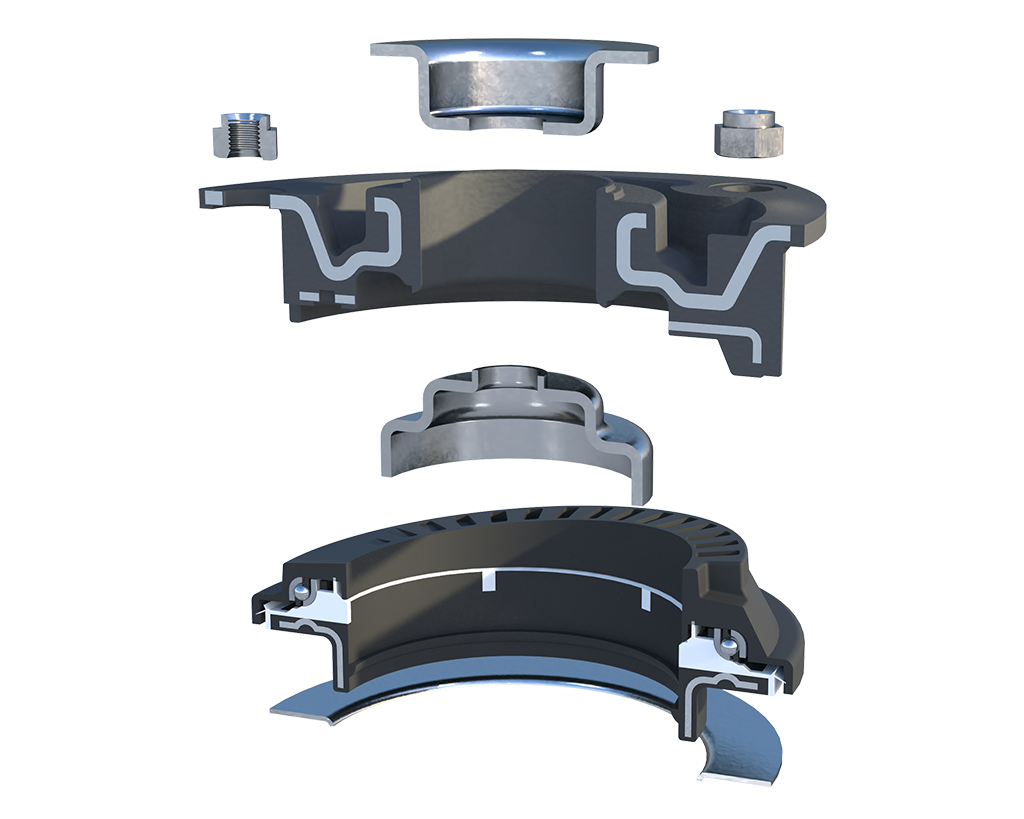
Rebound limiter
- Limits the rebound forces & movement
- Material (following OE design)
- Sheet metal, pressed into shape
- Aluminum
- Metal is painted or cataphoresis coated for corrosion protection
- Aluminum is sandblasted for clean finish
Outer & inner case
- Outer case mounted to the vehicle chassis
- Inner case holds the inner thrust bearing
- Bonded to the rubber core
- Material (following OE design)
- Sheet metal, pressed into shape, painted or cataphoresis coating for corrosion protection
- Aluminum; sandblasted for a clean finish
Rubber core
- Excellent metal-to-rubber bonding
- Shore & stiffness values according to OE design
- Damping of noise & vibrations (axial flexibility)
- Maintain correct wheel alignment (radial stiffness)
Spring seat housing
- Holding the spring seat and thrust bearing in place
- Mounted to the rubber core
- Mostly made out of durable Nylon:
- High strength
- Excellent temperature resistance
- Strong resistance to chemical substances
- Only applicable when spring seat is integrated (following OE-design)
Thrust bearing (front struts)
Allowing steering movements. Type according to OE design:
- Ball bearing:
- Polished chromium steel balls reducing friction
- Hardened ball races for maximum bearing strength
- Quality lifetime grease
- Roller bearing:
- Polished chromium steel rollers reducing friction
- Hardened roller races for maximum bearing strength
- Quality lifetime grease
- Applicable for heavier loads
- Hydrodynamic bearing:
- Reduced metal-to-metal contact
- Increased lifespan
- Excellent damping functionalities
- Limited load capacity due to low operating speed
Spring seat reinforcement
- Metal reinforcement ring for the spring seat
- “Cup”-design for extra strength
- Only applicable if seat is integrated in the housing
Spring seat
- Metal ring
- Connects the spring to the strut mount
- Can be integrated in the strut mount; bearing or available as separate part according OE-design
Strut mounts in car suspension systems can fail due to a combination of factors that lead to wear over time. One primary cause is constant exposure to road impacts and vibrations, which gradually degrades the rubber components within the mount. Over time, this can result in cracking, splitting, or flattening of the rubber, reducing its ability to absorb shocks and dampen vibrations.
The same vibrations, impacts and load variations also impact the bearing inside the strut mount. This part allows all steering movements and is continuously rotating , so it is naturally subject to wear. Frequent impacts and stress will definitely accelerate the wearing process. A high-quality strut mount replacement is therefore essential to guarantee a durable and comfortable ride. Excellent rubber quality, rubber bonding and durable thrust bearings, designed to support load variations, will ensure proper suspension behavior.


