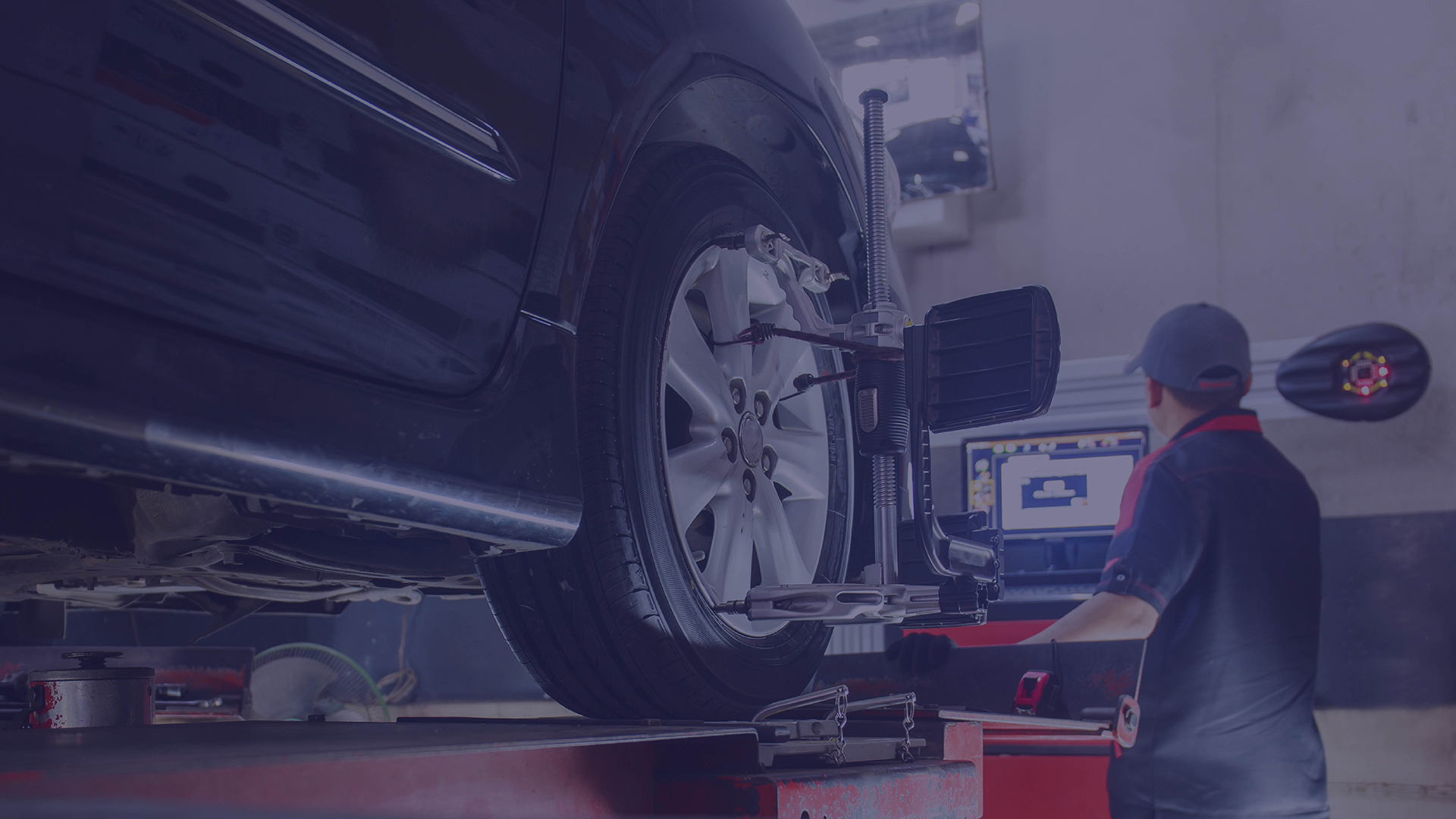
WHEEL ALIGNMENT CHECKLIST.

1. VEHICLE PREPARATION AND INSPECTION.

  • Check and correct the tire pressure according to the factory instruction.
  • Remove any surplus load and ensure a neutral load condition.
  • Carry out a visual check of the tires, rims and wheel suspension.
  • Clean the rim edges to ensure correct mounting of the measuring equipment.

2. SUSPENSION AND STEERING GEAR INSPECTION.

  • Check the steering knuckle balls, track control arms, gaiters, steering balls and bearings for play or wear.
  • Check the driving height; sagged suspension springs affect the measurement.
  • Repair defects before starting the alignment.

3. POSITIONING ON THE ALIGNMENT RACK.

  • Position the vehicle straight and centered onto the alignment rack.
  • Unlock the steering wheel; put the front wheels on turnplates, the rear wheels on slip-plates.
  • Move the car slightly onto the springs to stabilize the suspension.

4. SETTING UP THE ALIGNMENT EQUIPMENT.

  • Start the 3D or CCD system and select the correct vehicle data.
  • Check the factory specifications for the wheel positions.
  • Calibrate the system and make sure that sensors or cameras are correctly positioned.

5. MOUNTING THE MEASURING HEADS & RIM COMPENSATION.

  • Carefully fix the measuring heads or reflectors to the rims.
  • Perform a rim stroke compensation to neutralize any rim deviations.
  • Ensure a clear view of the sensors or reflectors to the cameras.

6. CARRYING OUT THE ALIGNMENT MEASUREMENT.

  • Carry out the measuring cycle as per the system’s instructions.
  • Measure camber, caster, and toe for each wheel.
  • Analyze the measurement report; determine which angles should be adjusted.

7. ADJUSTING THE REAR WHEELS (IF ADJUSTABLE).

  • Start by adjusting camber, followed by toe.
  • Use eccentric bolts, adjustment arms or adjusting screws.
  • Correct the thrust angle up to nearly 0°.
  • Recheck the measurements after every adjustment.

8. ADJUSTING THE FRONT WHEELS.

  • First adjust caster (if adjustable), then camber and finally toe.
  • Work symmetrical and keep the steering wheel in the driving straight ahead position (use the steering-wheel lock).
  • Adjust both tie rods proportionally to keep the steering wheel centric.
  • Check after each intermediate step on the measurement screen.

9. FIXING AND LOCKING.

  • Tighten all the bolts, nuts and lock nuts using the correct torque.
  • Use a torque wrench; avoid pneumatic wrenches for fine-tuning.
  • Replace corroded or damaged adjusting screws, if necessary.

10. FINAL MEASUREMENT AND REPORTING.

  • Carry out a control measurement to confirm the final values.
  • Generate a pre- and post-report using the alignment software.
  • Document the report for the customers and for internal use.

11. TEST DRIVE AND FINALIZING.

  • Make a test drive on a flat road; check the wheel position, driving straight ahead and steering-wheel return.
  • Correct if necessary by fine-tuning.
  • Check if the ADAS systems require recalibration after the alignment (cameras, radars).
  • Finalize with customer information and professional advice.

Related tips

Wheel geometry parameters.

Professional wheel alignment requires more than just modern equipment. It also requires insight into vehicle technology, interpretation of data as well as manufacturers knowhow.

Read more
Why wheel alignment is essential.

Each intervention at the suspension or steering parts directly affects the wheel positions. The smallest deviation in camber, caster or toe has an impact on tire wear, changed driving behavior and vehicle stability.

Read more
How to replace strut mounts?

How to replace strut mounts in a few steps.

Read more